Monday, March 4, 2024

Graphene as an insulator. And nano-size hovercraft.


"Schematic representation showing how a graphene layer protects against water. The electrical current flowing along the edge of the topological insulator indenene remains completely unaffected by external influences. Credit: Jörg Bandmann, pixelwg" (ScitechDaily,Quantum Leap in Ultrafast Electronics Secured by Graphene’s Atomic Armor) If electricity transports water in one direction. The system can use the same effect to transport miniature robots on water. 


"Amalgamation of experimental images. At the top, a scanning tunneling microscopy image displays the graphene’s honeycomb lattice (the protective layer). In the center, electron microscopy shows a top view of the material indenene as a triangular lattice. Below it is a side view of the silicon carbide substrate. It can be seen that both the indenene and the graphene consist of a single atomic layer. Credit: Jonas Erhardt/Christoph Mäder)" (ScitechDaily,Quantum Leap in Ultrafast Electronics Secured by Graphene’s Atomic Armor) 


New electric systems require an extremely good insulator. Nanotechnology means that old-fashioned insulators are useless. A graphene membrane can protect components against water. The electric flow in the graphene makes it a good insulator that denies the inner side of the topological insulator getting outside effects. That kind of thing makes graphene one of the most interesting materials. The same thing that can make graphene repel water can be used in new nanotechnical solutions.

One of them is the nano-size robot that can hover above water. The system can make an electric load on graphene, and the system can hover above the layer using some nano-acoustic systems. That thing can make the small graphene hovercraft rise above the water layer. 


In a graphene structure, the fullerene balls are like small wheels that transport the miniature machine forward. There is the possibility that nano-diamonds send acoustic waves that make this system hover and move at least in liquids. In nanotechnology, small sizes of machines make them more effective and behave in other ways than their "big versions". 

In some models, graphene can trap water molecules. When the system turns the minus or plus poles in a certain way. It can be used to aim ion beams into the right position. The system can put behind the object, and then the ion cannon shoots ions. In that case, the opposite electric pole pulls ions into it. And that increases the ion system's accuracy. 

Graphene can also be used to trap water in it. The ability to change the direction of the water molecule makes it possible to create ultimate stealth materials. If the system can turn the molecule's positive or negative side outside, that thing makes this thing possible to create a layer that can pull electricity or radiowaves in it. 


https://scitechdaily.com/quantum-leap-in-ultrafast-electronics-secured-by-graphenes-atomic-armor/


https://learningmachines9.wordpress.com/2024/03/05/graphene-as-an-insulator-and-nano-size-hovercraft/

Ion beams are next-generation tools for nanotechnology, military, and medical use.


"Focused ion beam technology is pivotal in nanoscale materials processing, with a new EU report outlining its broad applications and potential for future breakthroughs in science and technology. Credit: SciTechDaily.com" (ScitechDaily, Ion Beams Unleashed: The Nanotechnology Game Changer)


Ion engines use ions as thrusters. The ion accelerator pushes ions back into the magnetic track. Then those ions will transport craft forward.  

Ion beams are particle flows that are formed by electrically loaded particles. The systems can use ion beams to transport material over distances. The system can ionize things like raw materials and send them to the receiver. That must only remove electricity from ions and turn them into neutral atoms. 

The ion beams can also destroy cancer cells and disinfect surfaces. In some visions. Sometimes in the future, the ion systems can used to create giant 3D structures. And that makes it possible to create space stations using ions and anions that are stored in tanks. But today we are far away from that thing. 

In nanotechnology, ion systems can play billiards with ionized atoms. And that thing makes it possible to create 3D structures. The accurate ion systems make it possible for the system. That can adjust the energy that focuses on the structure. The highly accurately adjusted energy allows those systems can shoot ions into the structure without breaking it, and that makes it possible to use them as highly advanced 3D printers. That can make very accurate atom structures. 


Acoustic or electromagnetic wormholes can allow the system to shoot ions in long range. The system can use a combination of acoustic wormholes and laser beams that make the ion channel through the air. If the wormhole or eruption channel is empty enough. 

That can be used to shoot antimatter particles to the target. In those cases, the antimatter particles must not touch the material. The photon or laser accelerators can pull energy to the ions and anions when they fly through the wormhole. 

Ion beams can used in highly advanced military systems. If in the negative ion beam are also protons or positive ions that help to keep the beam in the formation. The ion cannon can shoot ions in long distances if it shoots that particle flow through acoustic wormholes. 

The acoustic- or pressure wormholes are the channels in the air. The system can make them using some kind of acoustic system or the systems that shoot laser rays through the air. Lasers or some other electromagnetic radiation can used to make a plasma channel that allows the ion system to shoot ions in the long range. 


https://scitechdaily.com/ion-beams-unleashed-the-nanotechnology-game-changer/


Sunday, March 3, 2024

Solar power in rockets.


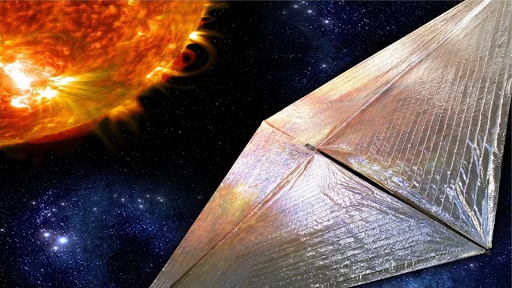
"NASA is developing solar sail technology for deep space exploration. This innovative propulsion system, powered by sunlight reflecting off its surface, has recently achieved a new readiness level, making it suitable for future science missions. Solar sails offer a fuel-free, environmentally friendly method of propulsion, capable of propelling low-mass missions to novel orbits and distant planets. Credit: NASA" (ScitechDaily, Harnessing Helios: The Science Behind NASA’s Solar Sail Breakthrough)

In traditional form solar sails get their movement energy from the sun. The solar wind pushes that thing into the interplanetary journey. The solar wind is an effective thruster. However, its use is limited in the internal solar system, inside the asteroid belt. 

But some active components may make those things more effective than they were. There are models where there are small gas pockets or gas tanks in the solar sail. And when solar energy hits the craft, it boils that gas.  

There are also plans for the solar rocket engines. Those engine systems use liquid hydrogen as a propellant. 

In those systems, the large parabolic mirror makes that propellant boil and expands it. The parabolic mirror drives sunlight in that propulsion system. 

There could be a thermal element like carbon fiber or ceramic point, and the sunlight haets that element. When the system drives hydrogen into that point the heat expands it and forms the thrust. In some other versions, the system conducts solar panel energy to the thermal element. And that expands the hydrogen. Solar power also can used in ion motors. The ion accelerators can get their electricity from solar panels. 


The solar sail can pull nuclear or antimatter rockets to the edge of the asteroid belt. 


Solar sails are multi-use systems. The large surface of those sails can also act as a radar antenna. And they can use solar power to accelerate the craft into the journey. It's possible. Solar sails can covered with some other elements like plutonium or methane ice, and then laser rays will start to vaporize that material. Also, things like ion cannons can benefit the acceleration process. If solar sails use hybrid technology, that thing is more interesting than just sailing. 

In some visions, there would be giant lasers in our solar system. There those laser systems accelerate the solar sails when they are too far from the sun. That allows them to transport space probes to the Kuiper belt. 

NASAs breakthrough in solar sail technology is interesting because solar sails are cheap to make. They don't need internal fuel. The solar wind or particle flow from the sun accelerates solar sails. There is the possibility that solar sails can pull small nuclear or antimatter rockets to the edge of the asteroid belt. And then those rockets can continue their journey to the gas giants and the Kuiper belt. 

The antimatter engine can produce an antimatter load from the solar wind. And that is one of the things, that makes solar sails interesting. In those cases, the solar sail will travel near the sun first. After that, the solar sail will open, and the particle load from the sun will accelerate to journey. 


https://scitechdaily.com/harnessing-helios-the-science-behind-nasas-solar-sail-breakthrough/


The new shapes and new materials are revolution in aerospace technology.


"NASA’s X-59 quiet supersonic research aircraft is dramatically lit for a “glamour shot,” captured before its January 12, 2024, rollout at Lockheed Martin’s Skunk Works facility in Palmdale where the airplane was constructed. Credit: Lockheed Martin / Michael Jackson" (ScitechDaily, NASA X-59 Experimental Aircraft’s Quiet Revolution in Supersonic Flight)


The X-59 Qesst (Quiet SuperSonic Technology) means a new shape for supersonic and hypersonic aviation. This type of system is extremely streamlined. And that makes it very thin and gentle pressure waves. Those pressure waves travel as long as possible before they hit to ground. And that means those pressure waves can deliver as much energy as possible before they reach the ground. 

That technology is useful in both, super- and hypersonic bodies. The silent supersonic and hypersonic systems can revolutionize things like civil and military aviation, and if those turbines use hydrogen, they will not cause emissions. The same thing that makes those next-generation systems quiet makes them hard to detect. 


The new materials decrease the aircraft's weight and radar signatures. 


New materials like nano-printed titanium have also revolutionized aviation. That new material is 50% stronger than aerospace titanium. The nano-titanium has better thermal abilities than regular, or homogenous titanium. It's possible that in that structure there are things like fullerene or some very cold particles that pull thermal energy in out from the main structure. 

In some models, engineers can put things like electronegative particles like protons (hydrogen ions) in that structure. The idea is that when radio waves hit to outer shell, that electronegative structure pulls those radiowaves inside this material structure. Engineers can cover the outer shell of aircraft with very thin structures like nanonet which is a very lightweight composite metal-graphene combination. It's possible that in that structure are small nano-balls that roll when the aircraft moves through the air. 


"PhD candidate Jordan Noronha holding a sample of the new titanium lattice structure 3D printed in cube form. Credit: RMIT" (ScitechDaily, Supernatural Strength: 3D Printed Titanium Structure Is 50% Stronger Than Aerospace Alloy)


The new metamaterials are the tools that make incredible things. The difference between those new metamaterials and traditional materials is that metamaterials or nanotechnical materials are created atom by atom. The chimeric materials  EM. radiation can jump into the structure that pulls it into itself. 

If an aircraft can transport thermal energy out from its body.  That will make the revolution for hypersonic technology. The biggest problem in high-speed flight is friction. This aircraft must remove this temperature or its structures will melt. 

The simplest way to transport heat out from the aircraft's body that decreases its temperature is to make ram-air travel between layers. That air will decrease the aircraft's temperature. But things like active thermal pumps can also make it possible to reach a speed, that is higher than before. 

That kind of material must deliver that stored energy somewhere. So, there can be some kind of thermal pump that transfers energy out of the structure. That thermal pump can be the laser ray or some kind of ion beam that travels in the plane. This thing should make radiation travel in one direction in the aircraft's body. 

That makes the aircraft more resistant to thermal effects. If an aircraft can remove the thermal effect from its body, that allows it to increase its speed. And that will be a breakthrough in the hypersonic technology. 


https://www.nasa.gov/mission/quesst/


https://scitechdaily.com/supernatural-strength-3d-printed-titanium-structure-is-50-stronger-than-aerospace-alloy/


https://scitechdaily.com/nasa-x-59-experimental-aircrafts-quiet-revolution-in-supersonic-flight/


https://en.wikipedia.org/wiki/Lockheed_Martin_X-59_Quesst


Saturday, March 2, 2024

The new prosthesis gives man feeling.


Technology advances. And modern prostheses might have the ability to feel things. This kind of prosthesis is a new tool for medical operations, and it can interact with the human nervous system using intelligent electrodes that deliver and receive nervous signals. 

This kind of system can used with intelligent neural wristbands. Those wristbands can connect the user's nervous system to the prosthesis. 

The same technology created for prostheses can used in hand-shaped manipulators. That prosthesis can also connected with a robot, that communicates with users over the internet. 

They can also used with remote-control human-shaped robots. In those systems, the controller can control robots using the BCI  (Brain-computer interface) or in more practical models the user can use the VR (Virtual Reality) Glasses, data gloves, and intelligent wristbands, that send neuro-impulses to the robot. 

That new prosthesis can increase the ability to make people's lives better after the amputation. These kinds of tools are turning human-robot hybridization closer. And that also improves the ability to use things. Like space suits and other protective systems. Technology created for that prosthesis can used to give the feel of touch to space suits. 


By the way...


In K.W Jeter's SciFi book Dr. Adder, the author predicted the weaponized prosthesis. The prosthesis uses a nuclear battery and it interacts with the human nervous system. The computerized prosthesis had IR cameras, that send the images to hand nerves. It used acoustic or laser systems whose mission was to destroy objects. Using modern nanotechnology is possible to create flat loudspeakers that can create sound that destroys red blood cells. 

This kind of system is possible to make quite soon. In some scenarios, surgeons can put that prosthesis on an amputated hand. And the surgeons who make that operation would put the hand into the cryogenics. 

When the mission is over the surgeon removes the prosthesis and reconnects the natural arm with the operator. The idea is stolen from the KGB execution machine, the high-voltage glove there are electrodes where there is high-voltage electricity. If that system touches a person, that causes deadly electric shocks. 


https://www.freethink.com/health/man-feels-hot-and-cold-again-with-prosthetic-hand-breakthrough


Friday, January 5, 2024

Harvard's futuristic wearable soft robot is an interesting tool.

  Harvard's futuristic wearable soft robot is an interesting tool. 


"Innovative research has developed a soft robotic garment that significantly reduces freezing episodes in Parkinson’s disease patients, offering a promising new approach to treatment and understanding of the disease. (Artist’s concept.) Credit: SciTechDaily.com." (ScitechDaily.com/Strides of Innovation: Soft Robotic Exosuit Improves Walking for People With Parkinson’s Disease)   

"The robotic garment (above), worn around the hips and thighs, gives a gentle push to the hips as the leg swings, helping the patient achieve a longer stride. Credit: Walsh Biodesign Lab/Harvard SEAS" (ScitechDaily.com/Strides of Innovation: Soft Robotic Exosuit Improves Walking for People With Parkinson’s Disease)

The new soft robot suit can give major help to Parkinson's patients. But it can make many new things. The Harvard developers developed a futuristic soft robot suite for Parkinson patient's that can correct their "freezing" moments. That soft robot suite can interact with muscles and nerves. The computer system sees when the freezing moment comes. And the robot suite can react to that thing. 

That robot suite can also be used by people who have brain injuries. Or bad balance. The robot suite sensors can see when a person falls. And then it can make counter-movement. That counter movement can done by using muscle stimulation. Or the system can use the tools that are connected to the robot suit. 

When a person loses balance or goes unconscious the robot suit can save a person from injuries and even dial the emergency number. Then the AI tells what is the problem. The robot suite can also send information on the body functions to the ambulance crew that comes to the place. The number and position of sensors determine what data that kind of system can collect. 

"Researchers at SEAS and the BU’s Sargent College of Health & Rehabilitation Sciences used a soft, wearable robot to help a person living with Parkinson’s walk without freezing. The robotic garment, worn around the hips and thighs, gives a gentle push to the hips as the leg swings, helping the patient achieve a longer stride. The research demonstrates the potential of soft robotics to treat a potentially dangerous symptom of Parkinson’s disease and could allow people living with the disease to regain their mobility and independence. Credit: Harvard SEAS" (ScitechDaily.com/Strides of Innovation: Soft Robotic Exosuit Improves Walking for People With Parkinson’s Disease)


The thing is that this kind of system can also be suitable in space and other extreme places. In the deep sea, those robots can used to save scuba divers in the case of nitrogen narcosis. Another thing is that those robots or their sensors can also used to control the exobodies. Exobody is the robot that the operator controls in augmented reality. The system can use the EEG curves to control the human-looking robot's actions. Or the system can use sensors that connect to angles. 

Those sensors are used to make human-looking animated cartoons. The same technology can used to control robots. The operator can control the "exobody" by using laser scanners and cameras that are in circles around the operator. Then the operator must only make movements and the system transfers them to the exobody. 

An ability to take the body under control makes that kind of operation more flexible and safe than ever before. The robot suit can cooperate with the space suit. And when we think about wearable robot-space suits that thing can make it possible to create new types of tools to handle things like nuclear accidents. 

Especially the heavy space suit called the "white suit" is very resistant to radiation. That kind of space suit robots can used for cleaning operations in areas, where radioactive fallout is at a dangerous level. The white suit is developed to protect its users against cosmic radiation and high-speed electrons and helium nuclei. The hollow suite-looking robot can act as a rescue capsule. The system can take humans inside it, and then travel out from the danger zone. 

https://scitechdaily.com/strides-of-innovation-soft-robotic-exosuit-improves-walking-for-people-with-parkinsons-disease/

Colloid thrusters as plasma-stealth and electromagnetic compressor systems. For next-generation aviation.

 Colloid thrusters as plasma-stealth and electromagnetic compressor systems. For next-generation aviation. 


The "electrospray" can work also as a stealth system.


The ion engines can give poor thrust. But those kinds of systems can used to make the ion layer between radar and aircraft or ships. The ion engine can also used to create an ion trail behind the drones. That is flying between the aircraft and the ground. 

The "electrospray" can be a useful tool in combination with technology where thin ionization is used to create an ion layer over aircraft and ship hulls. That kind of system can make the next-generation plasma-stealth systems possible. 

In those plasma-stealth systems, the ion layer pulls radar impulses in ions or anions. And that thing denies the radar echo. In some other models, the ion system makes the plasma cloud that acts like a "chaff dispenser" and makes the false targets for radar-homing missiles. In some other versions, the system loads opposite polar electricity to the target. When the target is loaded with minus electric load, and ions are delivered to the air, that negative electricity pulls those ions like protons or nitrogen ions to that target. 

There are two ways to make the electrospray that denies radar see targets. The first one is that. The aircraft or ship covers its shell with an ion layer. The other system bases that fast-flying drones or manned aircraft will pull ionic trails behind them. That ion or anion trail will deny the radar impulses travel through it. 

SR-72


MQ-28 Ghost Bat

From Above: Lockheed SR-27 hypersonic testbed concept. And Boeing MQ-28 Ghost Bat. This type of drone can pull ion trail between the aircraft and radars. 

Colloid thrusters as plasma-stealth and electromagnetic compressor systems. For next-generation aviation. 


"Simple ramjet operation, with Mach numbers of flow shown" (Wikipedia/Ramjet)


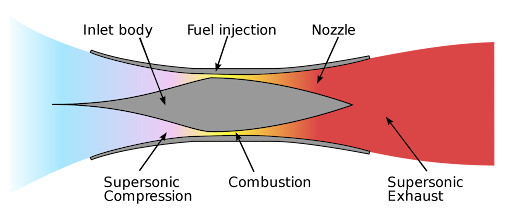
"Diagram of principle of operation of a scramjet engine" (Wikipedia/scramjet)


The problem with those systems is the lack of compressors. It's hard to make a mechanical compressor that accelerates the airflow to Mach 7. If the compressor rotates too fast it makes a vacuum around it. And that makes it impossible to put that compressor at the front of the ramjet or scramjet engine. That vacuum pulls exhaust gas forward and that engine stops to give thrust. And the centripetal force can also break a fast-rotating turbine. 

In some visions, the compressor is behind the Ramjet. And that vacuum that forms around the fast-rotating turbine wheel behind the exhaust tube pulls airflow through the engine. Another thing is to use an electromagnetic compressor that pulls ion flow through the ramjet or scramjet engine. 

That means the aircraft must reach Mach 1 so that the ramjet engine can start to operate. The scramjet requires about speed of Mach 7. That it can ignite fuel that is hydrogen. If the system uses magnetic accelerators and ions it could accelerate airflow to the needed speed while the aircraft is in a stable position. 


The colloid thruster could be a suitable tool for hypersonic aircraft. The system can ionize gas for magnetic compressors. 


The problem with the ramjet and scramjet engines is that they have no compressors. The mechanical compressor that can push air to the super-, and hypersonic engine with speeds of Mach 5+ is hard to make. One solution that can respond to that problem is the electromagnetic compressor. The electrospray system or colloid thruster can used as an auxiliary ionizers for ion compressors. The ion compressor system pulls ions like oxygen ions into the jet engines. 

That kind of system is suitable for ramjet and scramjet engines. The ionization makes it possible for engineers to create a system that can drive gas flow in supersonic or hypersonic engines. The system pulls ionized gas through the engine. And that gas flow travels with speed. That is high enough that the engine can ignite the hydrogen. That is suitable fuel for super- and hypersonic systems. The magnetic compressor uses magnetic fields to create the gas flow that allows it to ignite the fuel. 

The electrospray system also can make the ions for the electric jet engines. In electric jet engines, the combustion is replaced by using an electric arc. The system can use the magnetic compressor to collect ionized gas for the electric jet engine. Then the system makes an expansion for that gas by using an electric arc. That kind of engine system are very powerful tool for the next generation of very fast aircraft.


https://www.boeing.com/defense/MQ-28/index.page


https://forcaaerea.com.br/raaf-nomeia-como-mq-28a-ghost-bat-o-loyal-wingman/


https://interestingengineering.com/innovation/new-electric-jet-engine-actually-works-inside-the-atmosphere


https://militaryarmamentshub.com/admin/inside-the-top-secret-race-for-americas-first-hypersonic-aircraft/


https://scitechdaily.com/electrospray-technology-palm-sized-propulsion-for-future-space-missions/ 


https://en.wikipedia.org/wiki/Boeing_MQ-28_Ghost_Bat


https://en.wikipedia.org/wiki/Colloid_thruster


https://en.wikipedia.org/wiki/Lockheed_Martin_SR-72


https://en.wikipedia.org/wiki/Ramjet


https://en.wikipedia.org/wiki/Scramjet


If. We cannot cross the speed of light. We can make a shortcut through the fourth dimension.

What could interstellar supertechnology look like?  The WARP drive is something that we might not make quite soon. That system requires enor...